WAEC 2025 Geography Answers
(1a)
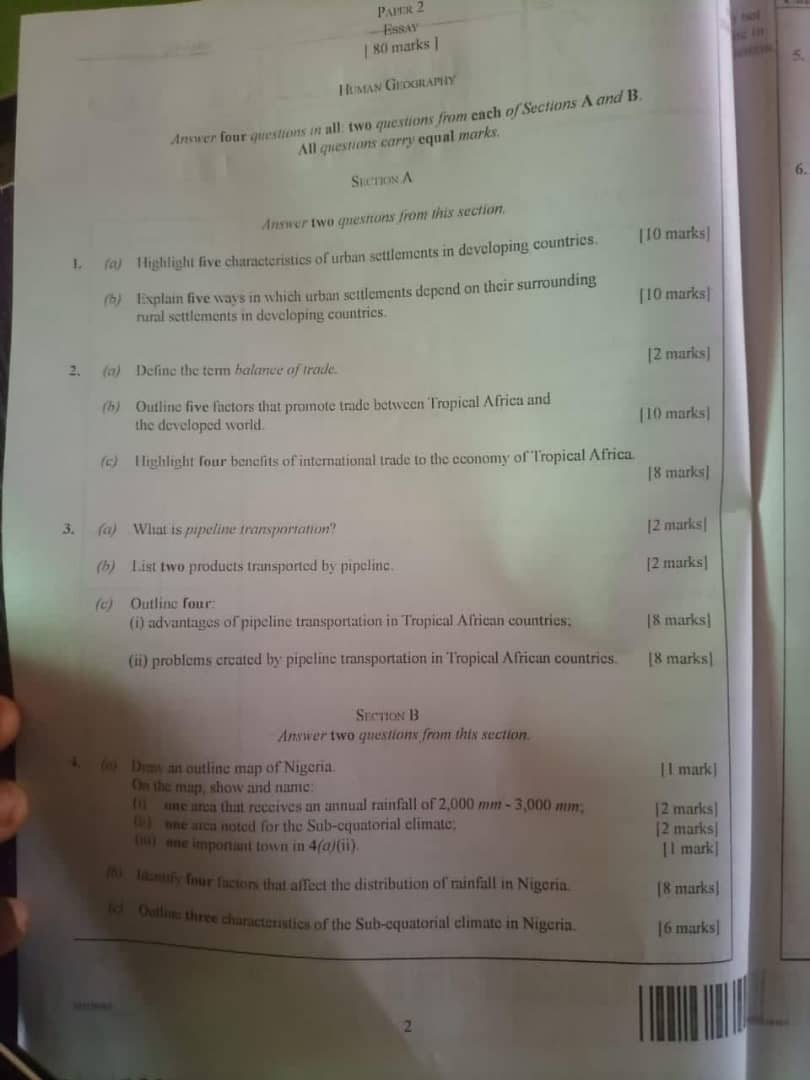
(i)Rapid population growth: Developing countries often experience high rates of urbanization as people migrate from rural areas to cities in search of opportunities.
(ii)Informal settlements:
Due to rapid urbanization and lack of affordable housing, many urban areas in developing countries have a significant presence of informal settlements or slums.
(iii)Inadequate infrastructure: Urban areas in developing countries often struggle with inadequate infrastructure, including limited access to clean water, sanitation, electricity, and transportation.
(iv)High levels of unemployment and
poverty: Despite the opportunities that cities offer, many urban residents in developing countries face high levels of unemployment and poverty.
(v)Social and economic
inequalities: Urban areas in developing countries often exhibit significant social and economic inequalities, with disparities in access to resources, opportunities, and services.
(1b)
(i)Food supply: Urban areas depend on rural settlements for their food supply, as rural areas are often the primary producers of agricultural products.
(ii)Labor force: Rural areas often provide a labor force for urban industries and services, as people migrate from rural areas to cities in search of employment.
(iii)Natural resources: Urban areas depend on rural areas for natural resources, such as water, timber, and minerals.
(iv)Recreation and tourism: Rural areas often provide recreational and tourist opportunities for urban residents, offering a break from the hustle and bustle of city life.
Cultural and social
(v)connections: Urban areas often maintain cultural and social connections with surrounding rural areas, as many urban residents have family and cultural ties to rural communities.
NUMBER THREE
(3a)
Pipeline transportation is the method of transporting liquids and gases through a system of pipes from one location to another. It is commonly used for the movement of petroleum products, natural gas, and water over long distances in a safe, efficient, and continuous manner.
(3b)
(PICK ANY TWO)
(i) Crude oil
(ii) Natural gas
(iii) Petrol (gasoline)
(iv) Diesel
(v) Water
(vi) Liquid chemicals
(3ci)
(PICK ANY FOUR)
(i) It helps to reduce road congestion and traffic accidents.
(ii) It is a cost-effective means of transporting large volumes over long distances.
(iii) It requires less maintenance compared to road and rail transport.
(iv) It provides a steady and uninterrupted flow of products.
(v) It minimizes environmental pollution when well-maintained.
(vi) It reduces the need for storage and handling at multiple points.
(3cii)
(PICK ANY FOUR)
(i) Vandalism and theft often lead to loss of products and damage.
(ii) The initial cost of constructing pipelines is very high.
(iii) Leakages and bursts can cause serious environmental pollution.
(iv) Construction and maintenance are difficult in remote or forested areas.
(v) Pipelines have fixed routes and limited flexibility.
(vi) Communities may be displaced during the laying of pipelines.