
NECO 2024 Data Processing Practical Questions Papers and Solutions are Available Now:
2024 NECO DATA PROCESSING ANSWERS
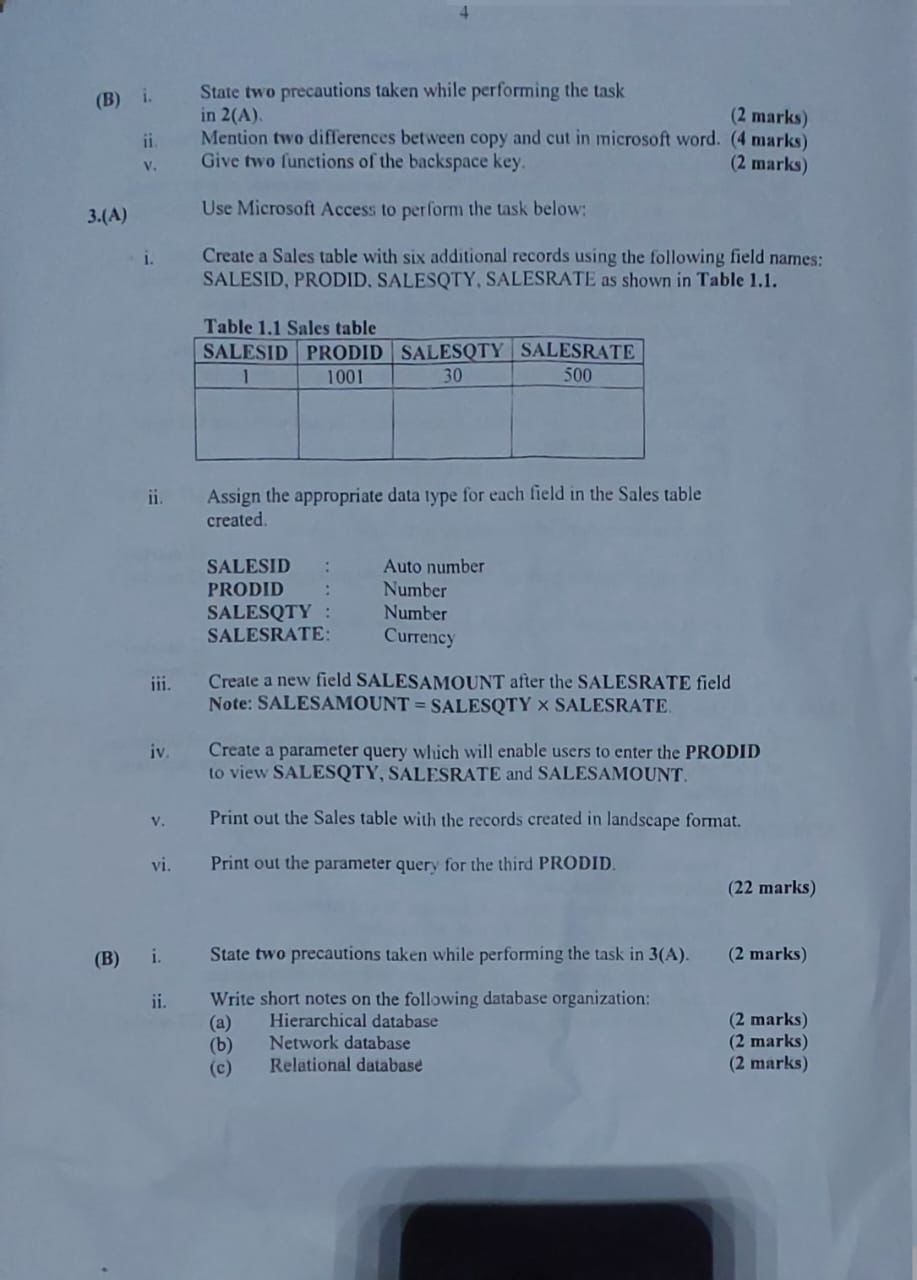
(1bii)
Graphic Package:
– A collection of visual elements, such as logos, icons, graphics, and images, designed to represent a brand or product.
– Typically includes various file formats (e.g., PNG, JPEG, SVG, EPS) and different resolutions.
– Used for branding, marketing materials, and visual identity.
Presentation Package:
– A set of visual aids, such as slides, graphs, charts, and images, designed to communicate information or tell a story.
– Often created using presentation software like PowerPoint, Google Slides, or Keynote.
– Used for presentations, meetings, conferences, and sales pitches.
(1biii)
(a) *Shape Tool:* Used to create and edit vector shapes, such as rectangles, ellipses, and polygons. It allows manipulation of nodes and curves to modify the shape.
(b) *Crop Tool:* Used to trim or mask an object or image to a specific shape or size. It removes or hides parts of the object outside the crop area, without affecting the original shape.
(2bii)
*Copy:*
– Duplicates the selected text or image, leaving the original in place.
– The copied content is stored on the clipboard, allowing you to paste it elsewhere in the document or in a different application.
*Cut:*
– Removes the selected text or image from its original location.
– The cut content is also stored on the clipboard, allowing you to paste it elsewhere in the document or in a different application.
(2bv)
1. *Delete character to the left*: Pressing Backspace deletes the character to the left of the cursor.
2. *Delete selection*: If text is selected, pressing Backspace deletes the entire selection.
3. *Move cursor left*: If no character is selected, pressing Backspace moves the cursor one character to the left.
4. *Delete previous character in a field*: In some applications, Backspace deletes the previous character in a field, such as a web address or search bar.
5. *Navigation*: In some programs, Backspace acts as a navigation shortcut, taking you back to a previous page or level.
(3bii)
(a)A hierarchical database is a type of database that organizes data in a tree-like structure, with each record having a single parent record and multiple child records. This structure is similar to a file system, where directories and subdirectories are organized in a hierarchical manner.
KEY FEATURES OF HIERARCHICAL DATABASES:
(i)Data is organized in a tree-like structure
(ii)Each record has a single parent record and multiple child records
(iii)Relationships between records are represented as links between nodes
(iv)Data is stored in a series of segments, each containing a group of related records
(v)Supports fast data retrieval and efficient data storage
EXAMPLES OF HIERARCHICAL
(i)IBM’s IMS (Information Management System)
(ii) Windows Registry
(iii) XML (Extensible Markup Language) documents
*(B)* A network database is a type of database that organizes data as a network of interconnected records, allowing for multiple relationships between records. This model was developed to overcome the limitations of hierarchical databases.
IN A NETWORK DATABASE:
(i)Data is stored as a collection of records, called nodes or segments
(ii)Each record has multiple parents and children, forming a web-like structure
(iii)Relationships between records are represented as links or pointers
(iv)Each record can have multiple owners and multiple members.
FEATURES OF NETWORK DATABASES
(i)Multiple relationships between records
(ii)Flexible data modeling
(iii)Efficient data storage and retrieval
(iv)Support for large-scale applications
EXAMPLES OF NETWORK DATABASES
(i)IDS (Integrated Data Store)
(ii)IDMS (Integrated Database Management System)
(iii)Network models like the CODASYL (Conference on Data Systems Languages) model
*(C)* A relational database is a type of database that organizes data into one or more tables, with each table having rows and columns, similar to an Excel spreadsheet. Each row represents a single record, and each column represents a field or attribute of that record.
IN A RELATIONAL DATABASE:
(i)Data is stored in tables, with each table having a unique name
(ii)Each table has rows (records) and columns (fields)
(ii)Data is manipulated using SQL (Structured Query Language)
Also Relational databases follow the relational model, which was introduced by Edgar F. Codd in 1970. The model is based on the concept of relational algebra, which uses mathematical operations to manipulate data.
FEATURES OF RELATIONAL DATABASES ARE:
(i)Data normalization
(ii)Data integrity
(iii)Data consistency
(iv)Support for querying using SQL
EXAMPLES OF RELATIONAL DATABASES
(i)MySQL
(ii)PostgreSQL
(iii)Microsoft SQL Server
(iv)Oracle


DATA PROCESSING PRACTICAL SPECIMEN


June/July NECO 2024 Data Processing Practical Questions Papers Are Already Available:
QUESTION PAPERS:
Uploading ……. 79%
ANSWERS:
SOLVINGS/ TYPING…… 90%
NOTE:- You can get NECO 2024 Data Processing Practical Questions Papers and Solutions Now on WhatsApp with just N1,000. Kindly chat 08059274646 on WhatsApp now if you’re interested in it.
CLICK HERE TO DOWNLOAD ALL NECO 2024 DATA PROCESSING PRACTICAL QUESTION PAPERS