
OFFICE OBJ
01-10: CEBBBBCCBB
11-20: AADEEABBDA
21-30: DECEABBCDA
31-40: EDBBADBCEC
41-50: ABDDCBCDBC
51-60: BEADDEADCD
COMPLETED
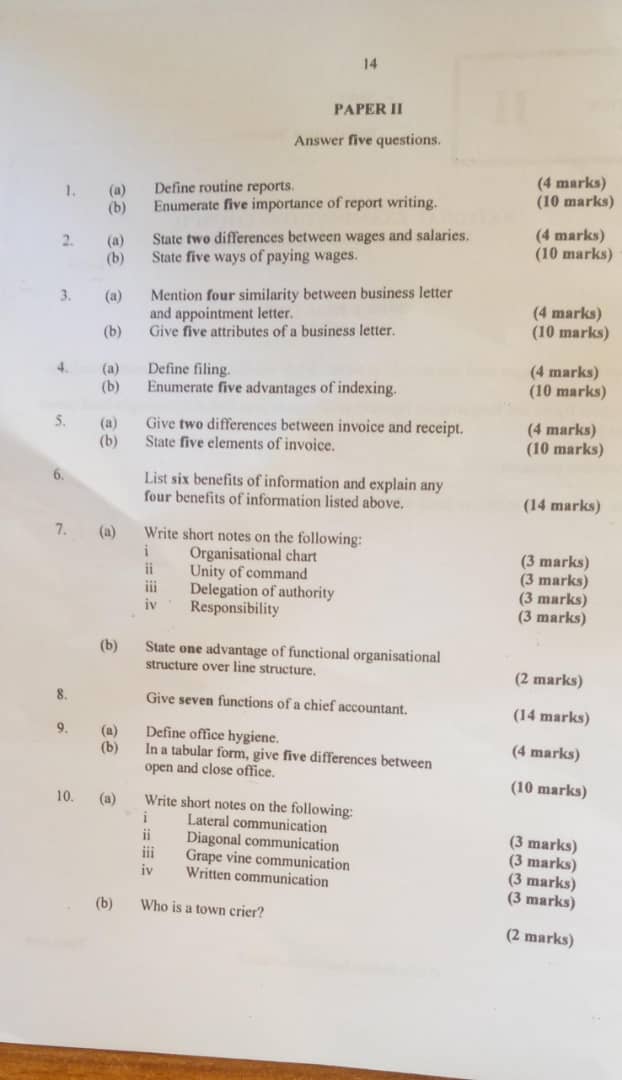
NECO OFFICE PRACTICE
NUMBER ONE
(1a)
Routine reports refer to regular, recurring reports that are generated on a consistent schedule, such as daily, weekly, monthly, or quarterly. These reports are typically used to provide information about ongoing activities, performance metrics, or any relevant data that needs to be regularly communicated.
(1b)
(PICK ANY FIVE)
(i) Communication and Documentation: Reports provide a structured way to communicate information, findings, and recommendations to relevant stakeholders, such as management, clients, or other departments.
(ii) Decision-making Support: Well-written reports present data and analysis in a clear and concise manner, enabling decision-makers to make informed decisions based on the information provided.
(iii) Accountability and Transparency: Reports serve as a record of activities, progress, and outcomes, promoting transparency and accountability within an organization.
(iv) Performance Tracking: Routine reports can help track and monitor key performance indicators, allowing organizations to assess their progress and identify areas for improvement.
(v) Compliance and Regulation: In certain industries or contexts, reports may be required for compliance purposes or to meet regulatory requirements.
(vi) Knowledge Sharing and Organizational Learning: Reports can contribute to the organization’s knowledge base, providing a reference point for future projects or activities and facilitating organizational learning.
NUMBER TWO
(2a)
(PICK ANY TWO)
(i) Wages are typically paid based on the number of hours worked or the output produced. While Salaries are a fixed amount paid regularly, usually monthly or annually, regardless of the number of hours worked.
(ii) Wages are usually paid on an hourly, daily, or weekly basis. While Salaries are paid on a monthly or annual basis.
(iii) Wages are generally associated with manual or unskilled labor while Salaries are often associated with professional, managerial, or white-collar jobs.
(iv) Wages typically include overtime pay for hours worked beyond the standard work week while Salaries do not typically include overtime pay, as they are based on a fixed amount.
(v) Wages can be more flexible, as the total amount can vary based on the number of hours worked or the output produced while Salaries are more fixed and predictable, as the amount remains the same regardless of the number of hours worked.
(vi) Wages are subject to income tax, Social Security, and Medicare deductions. While Salaries are also subject to income tax, Social Security, and Medicare deductions, but the tax treatment may differ.
(2b)
(PICK ANY FIVE)
(i) Hourly Wage: Employees are paid based on the number of hours they work.
(ii) Piece-Rate Wage: Employees are paid based on the number of units they produce or the tasks they complete.
(iii) Salary: Employees receive a fixed amount of money regularly, usually on a monthly or annual basis.
(iv) Commission: Employees are paid based on the sales they generate or the revenue they bring in.
(v) Bonus: Employees receive additional compensation based on their performance, company profits, or other factors.
(vi) Tip-Based Wage: Employees in the service industry (e.g., waiters, bartenders) receive a portion of their income from tips left by customers.
(vii) Incentive-Based Wage: Employees are paid based on their ability to meet or exceed specific performance targets or goals.
(viii) Profit-Sharing: Employees receive a portion of the company’s profits, in addition to their regular wages or salary.
NUMBER THREE
(3a)
(PICK ANY TWO)
(i) Both business letters and appointment letters are formal written communications used for professional or official purposes.
(ii) They typically follow a similar formal structure, including a header, salutation, body, and closing.
(iii) The tone of both types of letters is usually formal and professional.
(iv) Both are addressed to a specific recipient, such as a client, customer, or colleague.
(v) Both types of letters require a high level of formality and attention to detail.
(vi) Both business letters and appointment letters carry significant weight and can have important implications for the recipient.
(3b)
(PICK ANY FIVE)
(i) A business letter should convey a professional and polished appearance.
(ii) The content of the letter should be clear, concise, and easy to understand.
(iii) The letter should be well-structured, with a logical flow of information.
(iv) The tone of the letter should be objective and free from personal bias or emotion.
(v) The letter should be free from grammatical, spelling, and formatting errors.
(vi) The content of the letter should be relevant and directly address the intended purpose.
(4a)
Filing is the process of systematically arranging and storing documents and records in a way that they can be easily retrieved when needed.
(4b)
(PICK ANY FIVE)
(i) Easy Retrieval: Indexing allows for quick and easy retrieval of documents, as it provides a systematic way to locate specific records without searching through all files.
(ii) Organization: It helps in organizing documents systematically, ensuring that records are arranged in a logical order that makes sense for the business or organization.
(iii) Efficiency: Indexing saves time and increases efficiency in managing files by reducing the time spent searching for specific documents.
(iv) Accuracy: Reduces errors in document handling and retrieval, as it minimizes the chances of misplacing or losing important records.
(v) Space Management: Helps in the efficient use of storage space by categorizing documents properly, preventing clutter and ensuring optimal use of available space.
(vi) Accessibility: Makes information accessible to multiple users simultaneously, as indexed records can be easily shared and referenced.
(vii) Backup: Acts as a backup for digital systems, ensuring information is not lost in case of technical failures or data corruption.
NUMBER FIVE
(5a)
(PICK ANY TWO)
(i) An invoice is a request for payment, while a receipt is a record of payment made.
(ii) An invoice is typically issued before payment, while a receipt is issued after payment is received.
(iii) Invoices have a more formal and structured format, while receipts can be more simple and informal.
(iv) Invoices usually provide more detailed information about the goods or services being charged, while receipts may be more concise.
(v) Invoices have more legal significance as a record of a financial transaction, while receipts are primarily for the customer’s records.
(vi) Invoices are typically kept for a longer period of time for accounting and tax purposes, while receipts may be kept for a shorter duration.
(5b)
(PICK ANY FIVE)
(i) Invoice number unique identifier for the invoice, often sequential.
(ii) Date: The date the invoice was issued.
(iii) Seller Information: The name, address, and contact information of the seller or service provider.
(iv) Buyer Information: The name, address, and contact information of the customer or client.
(v) Itemized List: A detailed list of the goods or services provided, including quantities, descriptions, and prices.
(vi) Payment Terms: The expected due date for payment and any applicable discounts or late fees.
More Answers Loading…..
CLICK HERE TO GET ALL NOW IN OUR WHATSAPP GROUP!!!