
WAEC GCE AGRICULTURAL SCIENCE
AGRIC OBJ
01-10: BCBAACBDDB
11-20: DBCAACACAD
21-30: CDCCAADCAA
31-40: ACDADDABBD
41-50: BBACCAADCB
COMPLETED
THEORY
(1ai)
Finance:
(i) Limited access to credit inhibits farmers’ ability to invest in inputs and equipment.
(ii) High interest rates increase the cost of borrowing, making it difficult for farmers to obtain necessary funds.
(iii) Insufficient financial resources restrict farmers’ capacity to adopt modern agricultural practices.
(iv) Inadequate capital limits the ability to purchase improved seeds, fertilizers, and machinery.
(1aii)
Storage facilities:
(i) Lack of proper storage infrastructure leads to post-harvest losses due to spoilage and pests.
(ii) Inadequate storage facilities restrict farmers’ ability to store and market their produce effectively.
(iii) Insufficient cold storage facilities limit the accessibility of perishable goods, reducing their market value.
(iv) Poor storage capacity hampers the ability to benefit from seasonal price fluctuations and engage in value-added activities like processing.
(1bi)
Farm planning is the process of designing and organizing various operations and activities on a farm to maximize productivity, efficiency, and sustainability.
(1bii)
(PICK FOUR ONLY)
(i) Land availability and suitability for farming.
(ii) Access to water sources for irrigation and livestock.
(iii) Climate and weather patterns affecting crop growth and animal welfare.
(iv) Market demand for the selected crops or livestock products.
(v) Availability and cost-effectiveness of farming inputs such as seeds, fertilizers, and equipment.
(vi) Farm management skills and labor availability.
(vii) Environmental sustainability and conservation practices.
(viii) Economic viability and financial planning for the farm business.
(1c)
(PICK FOUR ONLY)
(i) Effective farm planning helps determine the optimal allocation of resources such as land, labor, and capital for maximum productivity.
(ii) Farm planning ensures efficient utilization of available land by considering factors like crop rotation, soil health, and suitable production systems.
(iii) It facilitates the development of realistic production goals and targets for the farm.
(iv) Farm planning aids in mitigating risks associated with fluctuating market conditions and environmental uncertainties.
(v) It enables the adoption of sustainable farm practices by promoting conservation measures and the use of renewable resources.
(vi) Effective farm planning allows for the optimization of input use, minimizing wastage and reducing expenses.
(vii) It helps in the diversification of farm enterprises, leading to increased income streams and enhanced resilience to market fluctuations.
(viii) Farm planning promotes long-term strategic decision-making, facilitating the development and growth of the farm enterprise.
NUMBER TWO
(2ai)
Symbiotic Nitrogen Fixation:
(i) Through the association of leguminous plants with nitrogen-fixing bacteria in root nodules.
(ii) Through the association of non-leguminous plants with nitrogen-fixing bacteria in specialized structures.
(2aii)
Electrical Discharge:
(i) Through lightning strikes, which convert atmospheric nitrogen into nitrate or nitrite.
(ii) Through electrochemical reactions in the soil, converting atmospheric nitrogen into ammonium ions.
(2aiii)
Ammonification:
(i) Through the decomposition of organic matter by soil microorganisms, releasing ammonium ions.
(ii) Through the breakdown of proteins and urea present in animal waste, releasing ammonium ions.
(2bi)
Monocotyledonous crops have a single seed leaf while dicotyledonous crops have two seed leaves.
(2bii)
(I) Monocotyledonous crops:
(i) Rice
(ii) Corn
(iii) Wheat
(II) Dicotyledonous crops:
(i) Soybean
(ii) Cotton
(iii) Tomato
(2c)
(PICK FOUR ONLY)
(i) Excessive use of synthetic fertilizers.
(ii) Overgrazing by livestock.
(iii) Deforestation and land clearing.
(iv) Poor irrigation and water management practices.
(v) Improper crop rotation and monoculture planting.
(vi) Soil erosion due to improper tilling and land management.
(vii) Heavy pesticide and herbicide use.
(viii) Inadequate waste management and disposal of agricultural by-products.
NUMBER THREE
(3a)
(i) Green Manure: Green manure involves growing and incorporating specific crops into the soil while they are still green or shortly after flowering. These crops add organic matter to the soil, improve fertility, and prevent soil erosion.
(ii) Farmyard Manure: Farmyard manure consists of organic material such as dung, urine, and bedding collected from farm animals. It is decomposed and used as a natural fertilizer to enhance soil structure and nutrient content.
(iii) Compost: Compost is a mixture of decomposed organic matter, such as kitchen waste, leaves, and plant residues. The composting process transforms these materials into a nutrient-rich soil conditioner that improves soil structure and fertility.
(3bi)
(1) Diversification: Reduced risk as income is derived from various sources.
(2) Nutrient Cycling: Integration of crops and livestock allows for efficient nutrient cycling.
(3) Risk Management: If one enterprise faces challenges, others may provide a safety net.
(ii)
(1) Management Complexity: Handling different enterprises requires diverse skills and management strategies.
(2) Market Uncertainty: Market conditions for various products may fluctuate, impacting overall income.
(3) Resource Conflicts: Competing demands for resources, such as land and water, can arise among different enterprises.
(3c)
(i) Fishery Regulations:- Fishery regulations are rules and guidelines established by authorities to manage and control fishing activities to ensure sustainable fisheries and conservation of aquatic resources.
(cii)
(1) Closed Seasons: Temporarily prohibiting fishing during specific periods to protect breeding and spawning seasons.
(2) Minimum Size Limits: Establishing minimum size limits for harvested fish to protect juvenile populations.
(3) Gear Restrictions: Regulating the types of fishing gear used to minimize environmental impact and prevent overfishing.
(4) Catch Limits: Setting limits on the quantity of fish that can be caught to prevent overexploitation and maintain fish stocks.
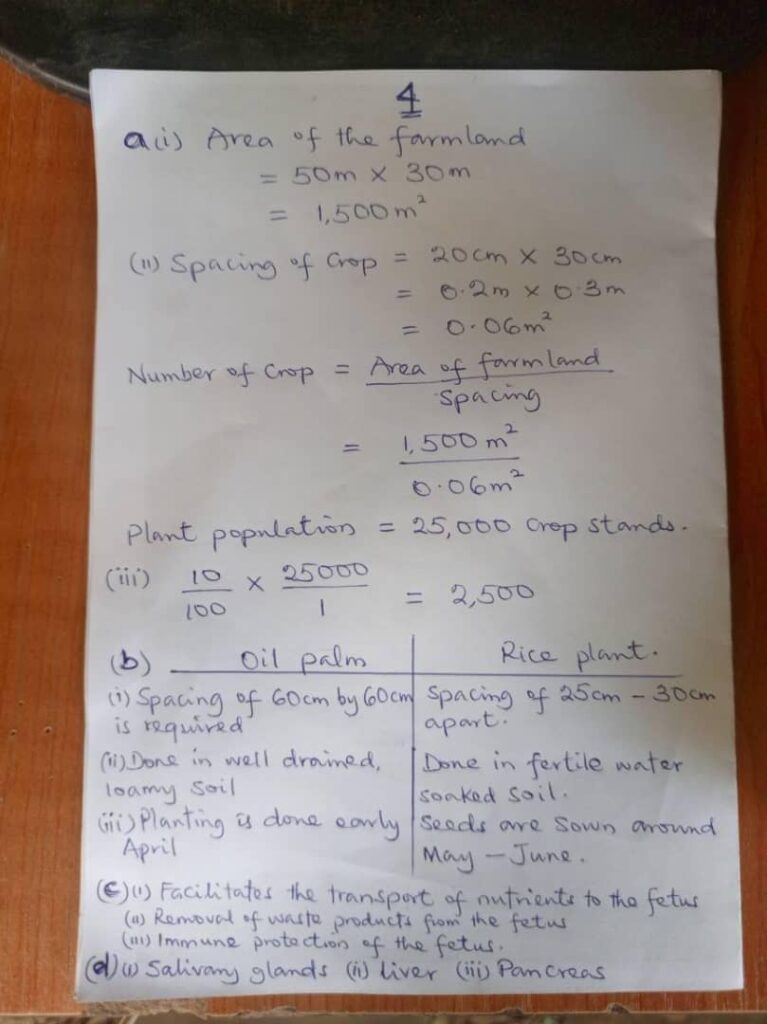
NUMBER FIVE
(5ai)
Artificial insemination refers to the process of introducing sperm into the reproductive system of a female animal without natural mating. This is commonly used in animal breeding to facilitate controlled and selective breeding.
(5aii)
(PICK ANY FIVE)
(i) Artificial insemination can be expensive due to the need for specialized equipment and trained professionals.
(ii) Conception rates with artificial insemination are generally lower compared to natural mating, as there can be challenges in properly timing the insemination.
(iii) Artificial insemination can increase the risk of spreading sexually transmitted diseases if proper hygiene and disinfection protocols are not followed.
(iv) Artificial insemination can lead to a reduction in genetic diversity, as the same few males may be used for breeding repeatedly.
(v) Artificial insemination requires trained professionals who possess the necessary skills and knowledge to perform the procedure correctly.
(vi) The equipment used in artificial insemination requires regular maintenance and calibration, which adds to the overall cost and complexity.
(vi) Artificial insemination bypasses the natural mating process, which can have negative effects on the natural behaviors and instincts of the animals.
(5b)
(PICK ANY FIVE)
(i) Farmers
(ii) Rural communities
(iii) Farming cooperatives and organizations
(iv) Youth in agriculture
(v) Women in agriculture
(vi) Agribusinesses
(vii) Government agencies
(5ci)
(i) Natural water sources
(ii) Artificial water sources
(5cii)
(PICK ANY FOUR)
(i) Hydration
(ii)Temperature regulation
(iii) Digestion
(iv) Milk production
(v) Cleanliness and hygiene
(vi) Disease prevention