
2024 NECO Financial Accounting Theory and Objectives Question Papers and Answers are Available Now.
F/ACCOUNTING OBJ
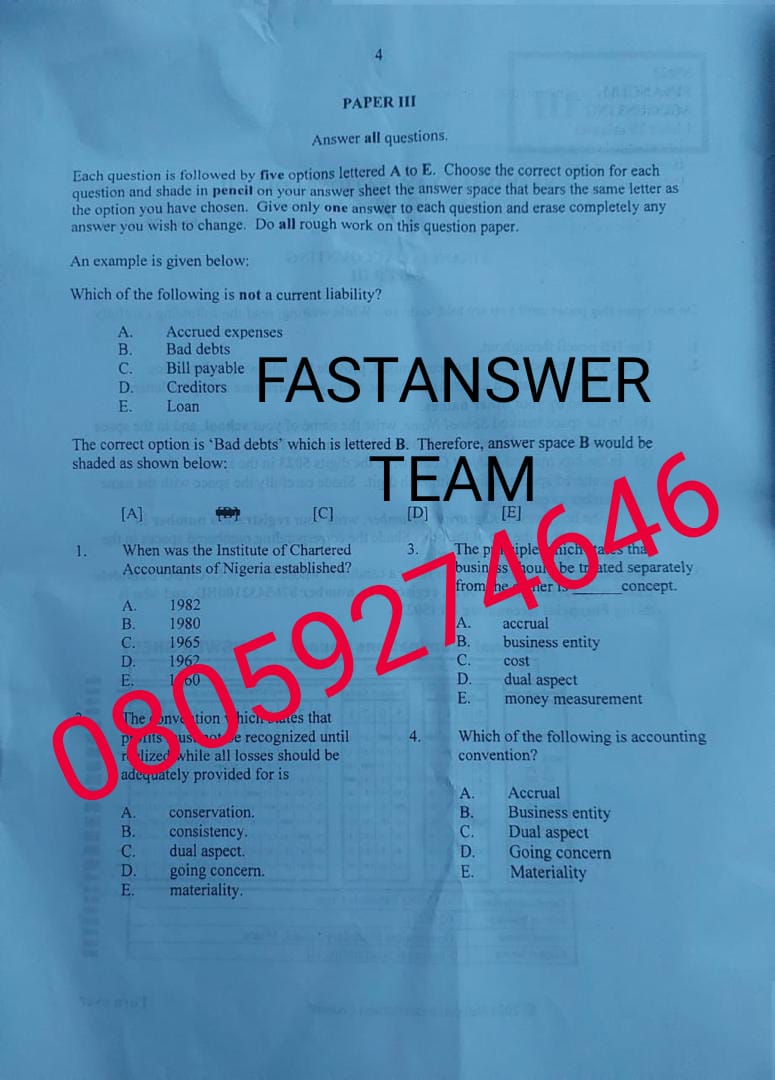
01-10: CABEDAAAAD
11-20: EDBCABECEA
21-30: CACBDDCCCB
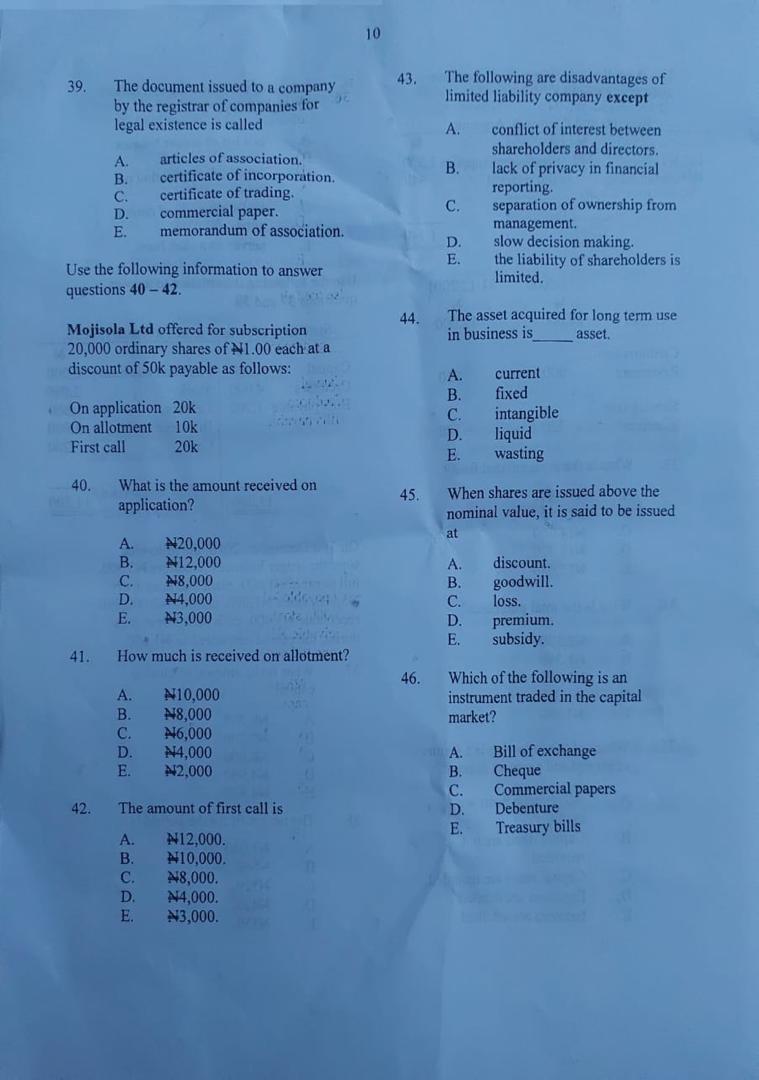
31-40: DDCDCDECBA
41-50: ABABDDCACE
51-60: CECCEACDDE
COMPLETED
NECO FINANCIAL ACCOUNTING
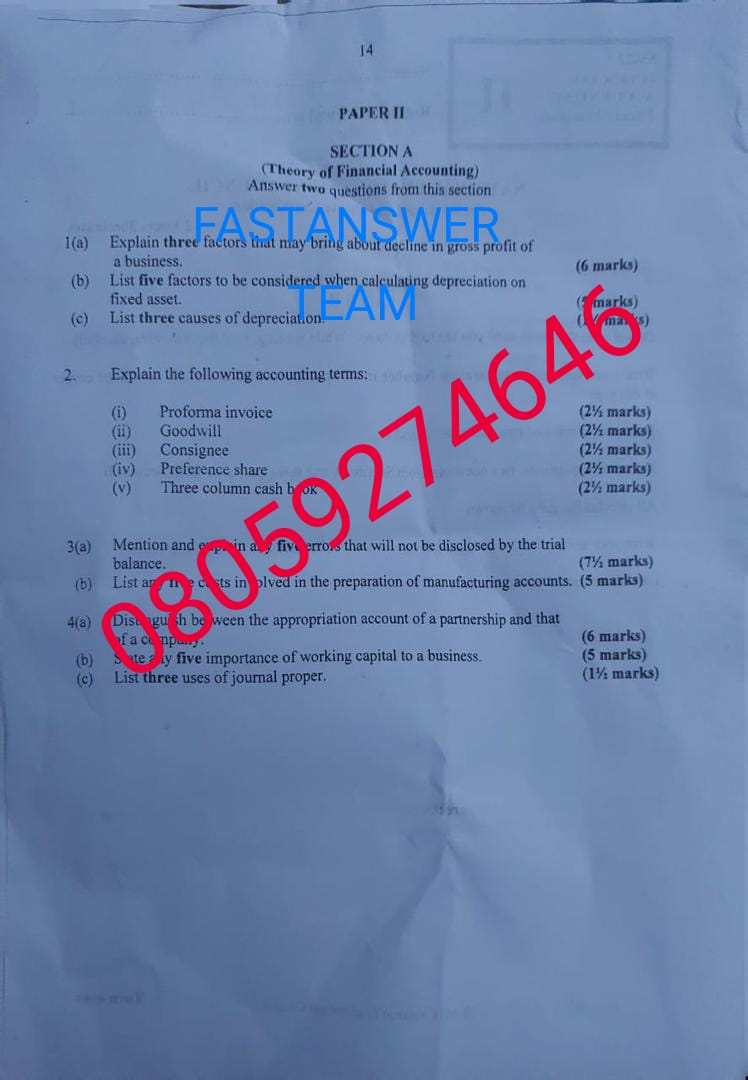
NUMBER ONE
(1a)
(PICK ANY THREE)
(i) Increase in the cost of goods sold: If the cost of raw materials or production increases, it can result in a lower gross profit margin.
(ii) Decline in sales volume: A decrease in sales can lead to lower revenue and hence a decline in gross profit.
(iii) Pricing pressure: Competitive pricing or pressure to lower prices can squeeze profit margins.
(iv) Inefficient operations: Poor inventory management, wastage, or high overhead costs can impact gross profit negatively.
(v) Economic factors: Fluctuations in the economy, such as inflation or recession, can affect consumer spending and business profitability.
(vi) Changes in customer preferences: Shifts in consumer trends or preferences can impact sales and ultimately gross profit.
(1b)
(PICK ANY FIVE)
(i) Cost of the asset
(ii) Useful life
(iii) Salvage value
(iv) Depreciation method
(v) Depreciation rate
(vi) Depreciation expense
(1c)
(PICK ANY THREE)
(i) Wear and tear
(ii) Obsolescence
(iii) Deterioration
(iv) Accidents or damages
(v) Inadequate maintenance
(vi) Time passage
NUMBER TWO
(2)
(i) Profit invoice: A profit invoice is a document issued by a seller to a buyer, indicating the amount of profit made on a transaction. It typically includes details of the cost price, selling price, and the profit margin. Profit invoices are useful for internal record-keeping and analysis of sales profitability.
(ii) Goodwill: Goodwill in accounting represents the intangible value of a business that arises from factors such as reputation, customer loyalty, brand recognition, and employee talent. Goodwill is often recorded on a company’s balance sheet when it is acquired through the purchase of another business. It is calculated as the excess of the purchase price over the fair value of the net assets acquired.
(iii) Consignee: A consignee is a person or entity to whom goods are sent or entrusted for the purpose of sale. The consignee takes possession of the goods but does not take ownership until they are sold. The consignee is responsible for selling the goods on behalf of the consignor and typically earns a commission on the sale.
(iv) Preference share: Preference shares, also known as preferred stock, are a type of equity security that gives shareholders preferential rights over common shareholders. Preference shareholders typically have a fixed dividend rate and priority in receiving dividends over common shareholders. In the event of liquidation, preference shareholders also have priority in receiving assets over common shareholders.
(v) Three column cash book: A three-column cash book is a type of cash book used in accounting to record cash transactions. It consists of three columns: the receipts column for recording cash inflows, the payments column for recording cash outflows, and the balance column for maintaining the running balance of cash on hand. The three-column cash book provides a comprehensive record of cash transactions and enables easy reconciliation of cash balances.
NUMBER THREE
(3a)
(PICK ANY FIVE)
(i) Errors of Omission: This occurs when a transaction is completely omitted from the accounting records. Since there is no entry, the trial balance will still balance.
(ii) Errors of Commission: These errors happen when a transaction is recorded in the correct type of account but in the wrong account (e.g., recording a sale to the wrong customer). Both debit and credit entries are made, so the trial balance still balances.
(iii) Errors of Principle: This occurs when a transaction is recorded in violation of accounting principles (e.g., recording a capital expenditure as a revenue expenditure). It affects the financial statements but not the trial balance.
(iv) Compensating Errors: When two or more errors cancel each other out (e.g., an overstatement of expenses and an overstatement of revenue by the same amount). The net effect on the trial balance is zero.
(v) Errors of Original Entry: These errors occur when the original amount entered in the books of prime entry is incorrect, and both the debit and credit sides are affected equally (e.g., recording $500 instead of $50).
(vi) Errors of Reversal: When the correct amount is posted but to the wrong side of the accounts (e.g., debiting the account that should be credited and vice versa). This still maintains the balance.
(vii) Errors in Duplicating Entries: When a transaction is recorded twice in the accounting records. Both entries will balance out each other in the trial balance.
(viii) Compensating Errors: When errors of equal magnitude occur in opposite directions in different accounts, they cancel each other out. For example, understating one asset and overstating another asset by the same amount.
(3b)
(PICK ANY FIVE)
(i) Direct Material Costs
(ii) Direct Labor Costs
(iii) Manufacturing Overhead Costs
(iv) Raw Material Inventory Costs
(v) Finished Goods Inventory Costs
(vi) Work-in-Progress Inventory Costs
(vii) Indirect Expenses
NUMBER FOUR
(4a)
-Appropriation Account of a Partnership-
(i) In a partnership, the appropriation account is used to distribute profits among partners according to the partnership agreement.
(i) The account records items such as salaries,interest on capital, and profit sharing ratios among the partners.
(iii) The appropriation account is specific to partnerships and reflects the sharing of profits among the partners.
-Appropriation Account of a Company-
(i) In a company, the appropriation account is used to allocate profits for various purposes such as dividends, reserves, and taxes
(ii) The account records items like dividends declared, transfers to reserves, and other appropriations as per company policy.
(iii) The appropriation account in a company reflects the allocation of profits for different uses as decided by the board of directors.
(4b)
(PICK ANY FIVE)
(i) Liquidity: Working capital ensures that a business has enough liquid assets to meet its short-term obligations.
(ii) Operating Cycle: It facilitates the smooth operation of the business by funding the operating cycle of purchasing, producing, and selling goods or services.
(iii) Flexibility: Sufficient working capital provides flexibility to take advantage of opportunities or face unexpected challenges.
(iv) Growth and Expansion: Adequate working capital helps in funding growth initiatives and expansion plans of the business.
(v) Debt Management: It helps in managing short-term debts and obligations effectively.
(vi) Inventory Management: Working capital plays a crucial role in managing inventory levels and ensuring smooth production and sales operations.
(vii) Creditworthiness: Sufficient working capital enhances the creditworthiness of the business and builds trust with suppliers and lenders.
(viii) Risk Management: It helps in mitigating financial risks and maintaining stability in operations.
(4c)
(PICK ANY THREE)
(i) Journal proper is used to correct accounting errors that cannot be rectified using other specialized journals.
(ii) It is used to record adjusting entries at the end of an accounting period for items like depreciation, accruals, and prepayments.
(iii) Journal proper is used for transferring transactions between different accounts within the general ledger.
(iv) It is used to record unusual transactions that do not fit into the standard journals like sales, purchases, and cash receipts.
(v) Journal proper is used to record opening entries when starting a new accounting period or business.
(vi) It is used for any other transactions that do not have a specific journal for recording, ensuring proper documentation and transparency in financial records.
QUESTION PAPERS:

ANSWERS LOADING >>>>>> 76%
NOTE:- You can get NECO 2024 Financial Accounting Theory and Objectives Question PAPERS and Answers now on WhatsApp with just N1,000 only. Kindly chat 08059274646 now.
CLICK HERE TO DOWNLOAD ALL FINANCIAL ACCOUNTING QUESTION PAPERS
Please i need it
Please I need it
Your comment here…Please i need it now
I’m expecting accounting question (Neco)
I need it
I need it